
Home Affairs
Immigration Records and Lost Citizenship in South Africa
by GenDatabase.com · 6 May 2026
Article
Did you know that during the late 1960s to early 1970s, the South African government made a decision that caused thousands of its own citizens to lose their nationality—often without their knowledge? This little-known policy had lasting consequences, many of which still surface today in official records and genealogy research.
A Policy That Changed Lives
In the late 1960s, the government introduced a rule that revoked the citizenship of South Africans who had been outside the country for longer than a specified period. This affected a wide range of people—many of whom had no idea their citizenship had been taken away.
Those impacted included:
- Individuals living in neighboring countries.
- Families residing in border regions that later became part of other nations.
- South Africans working abroad.
- People visiting relatives overseas for extended periods.
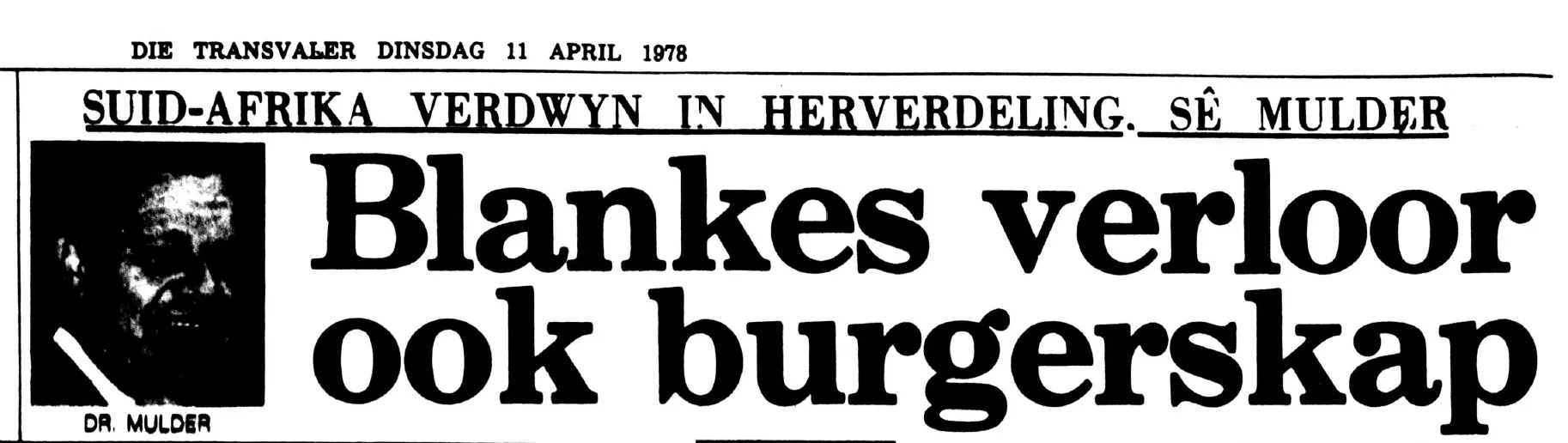
A report published in Die Transvaler (11 April 1978).
Legal Challenge and Reversal
The decision did not go unchallenged. It was eventually taken to court, where it was declared invalid. The ruling instructed the government to restore the citizenship of all affected individuals. While this was a significant legal victory, restoring citizenship in practice proved far more complicated.
The Role of the Electronic Population Register
In 1972, South Africa introduced its first Electronic Population Register—a major step in modernising record-keeping. However, the system came with limitations.
One key restriction: it could not directly reinstate citizenship status.
To work around this, officials used an unusual method—they added immigration records to reflect the restoration of citizenship. In some cases, individuals were even re-registered under categories such as asylum seekers and issued new identity numbers.
Restoring Citizenship—Often Too Late
Many South Africans never realised they had lost their citizenship in the first place. As a result, their records were only corrected much later—sometimes only after their deaths were reported to the Department of Home Affairs.
This led to unusual situations where:
- Citizenship status was updated after their death
- Immigration entries appeared in records of South African-born individuals
- New identity numbers were issued long after a person’s lifetime
Why This Matters for Genealogy Research
For genealogists, these records can be confusing at first glance. Seeing an immigration entry for someone clearly born in South Africa might seem like an error—but in most cases, it is not.
Instead, it often indicates that:
- The individual was outside South Africa during the late 1960s–1970s
- They were affected by the citizenship revocation policy
- Their citizenship was later restored through administrative workarounds
These records can actually be incredibly valuable. They may:
- Point to periods when a person lived abroad
- Provide clues about migration patterns
- Help researchers trace family connections in other countries
In fact, many researchers have used these records to uncover previously unknown branches of their family living overseas.